/CASE STUDY
CONTEXT
Providence is one of the largest not-for-profit healthcare systems in the U.S., serving patients across 52 hospitals and a broad network of clinics and care facilities. When I joined, 27 digital products had evolved independently, with no centralized component library, no shared documentation, and little consistency across core experiences. The result was an ecosystem that was harder for teams to build, maintain, and scale, and harder for patients and caregivers to navigate with confidence.
OPPORTUNITY
The issue was not just visual inconsistency, it was systemic fragmentation across design, engineering, accessibility, and brand. Teams were rebuilding the same patterns in parallel, only a small share of existing components met WCAG 2.1 AA standards, and inconsistent interactions were eroding trust across important healthcare touchpoints. The opportunity was to create Providence’s first centralized design system, one that could improve consistency, reduce redundancy, and establish a more reliable foundation for digital care.
DESIGNAPPROACH
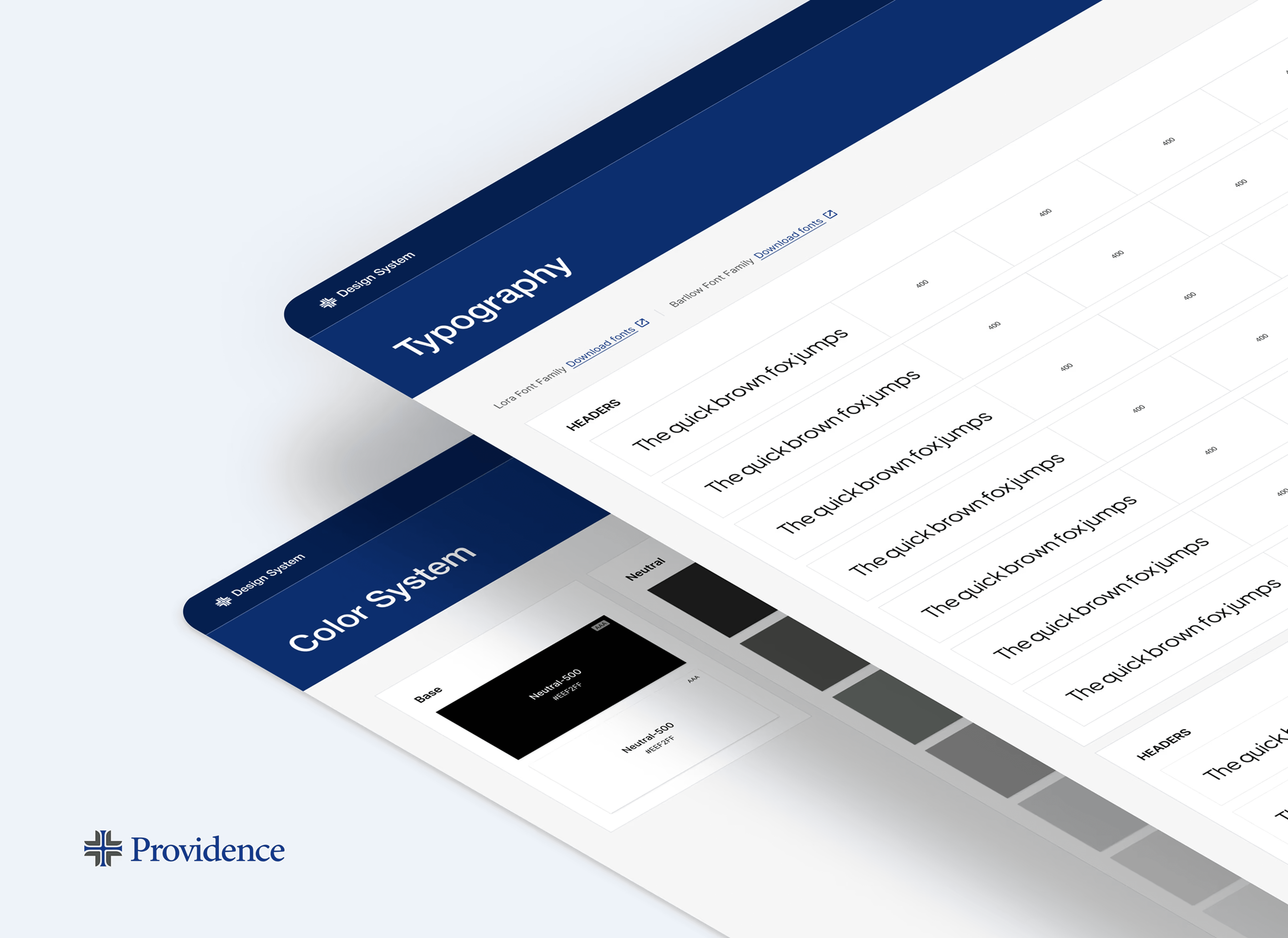
I led a cross-functional discovery effort that combined stakeholder interviews, product audits, and component analysis across Providence’s digital ecosystem, documenting the scale of duplication and using that research to build the business case for a system-wide initiative. From there, I defined the design principles, phased rollout, and documentation-first model, pairing a shared Figma library with a React component library, Storybook documentation, governance workflows, and accessibility standards built into the system from the start. To drive adoption, I treated internal teams as customers, piloted with early partners, and focused on making the system useful enough that teams wanted to adopt it.
IMPACT
The design system became a shared foundation across 19 products, and continues to support Providence’s digital ecosystem through a library of 127 components and patterns. It reduced design-to-development handoff time by 42 percent, delivered an estimated $3.2 million in first-year savings from reduced redundant work, achieved WCAG 2.1 AA compliance for all new features, and contributed to a 28 percent drop in patient support calls related to UI confusion. More importantly, it gave Providence a more consistent, trustworthy, and scalable way to design and ship digital experiences for both patients and caregivers.